

Retrieval practice is not just for younger students … it’s REALLY helpful in High School.
What is retrieval practice, and what are the benefits?
Retrieval practice (RP) is a form of low-stakes testing that really helps students learn. By ‘learn’ I mean ‘move material to their long-term memory’1. If it’s in their long-term memory it frees up their mental resources (working memory) to do lots of thinking about what you’re teaching. The more you know, the easier it is to learn. It also reduces the need to review and/or cram for any tests.
As a teacher RP gives you a wealth of information what they know, what they DON’T know, what needs more work, and what may even need re-teaching. See Cogsci In The Physics Classroom and Teaching students about learning and How do we learn*? for more info.
What does retrieval practice look like?
RP differs from a quiz or test (in the US) in some important respects:
- It’s low stakes (I’ll talk about grading later)
- It incorporates questions from recent work/work from a while ago*
- The questions become (over time) more complex and set in less familiar contexts.
*Technically, setting questions from a while ago is Spaced Practice.
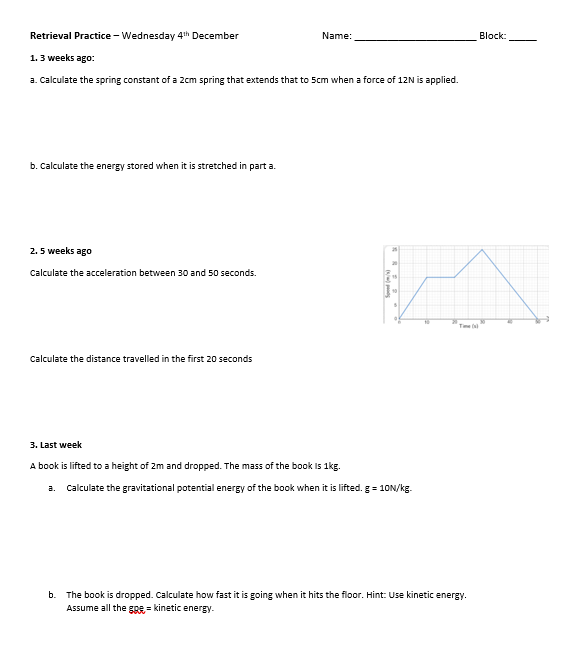
Here’s a semester’s worth of Physics RPs. You’ll see that in each topic the questions start easy (lots of recall) and become increasingly trickier. I also try to hit the misconceptions (of which there are many!) You could adapt this format for Biology or Chemistry (it’s a Word doc).
How does it work?
They come in lesson 1 each week and the RP is on the desk. They do it, leaving it blank if they don’t know. For a high school physics class, it takes about 10-15 minutes of a 75-minute lesson. It’s on their own, no books. You may wonder whether it’s worth spending that amount of time each week, but trust me! It pays off in the end. You get to speed up instruction because they have lots of knowledge to build on.
I collect them in and grade them, writing -1 or -2 next to anything that’s wrong. They’re always out of 10 (everything I set is out of 10, it makes for a much easier PowerSchool).
Next lesson, they come in and it’s back on their desk, but now they can correct it. Now they can use Book/Buddy/Me (I got this from the brilliant Blake Harvard why has Brain/Book/Buddy/Me). Does that mean they go and find the answer and write it down? Yes! Sometimes they defer corrections to a later time, like lunchtime or tutorial periods. I don’t mind as long as they do them!
VERY IMPORTANTLY, they have to write all corrections in a DIFFERENT COLORED PEN. That makes re-grading super easy and quick. They get them back the next lesson and keep them as a ready made set of review questions for later!
I know there are lots of views about this, but I give 100% credit for corrections because I want them to be motivated to do them. There are enough barriers to motivation in a subject like Physics that getting them ‘on side’ with this policy is a no-brainer.
RP in AP lessons
In the sense that the AP is a cumulative terminal examination it makes even MORE sense to do RP in AP lessons.
For RP at this level in class I use mini-whiteboards extensively (no grading), written questions that are marked in class/discussed, and later in the year, AP past paper questions.
The important point is to retain the principles that the questions you ask go from
- Recent material → material from a long time ago
- Easy/straightforward → hard/involving misconceptions
- Familiar → unfamiliar contexts
It’s essential that there is a wide range of questions to enable students to transfer what they know to the new situations that they meet.
Homework can also serve as a form of RP with spacing. Here’s some things that can max out the benefit for the students for the minimal amount of time spent grading.
- Set the work relating to this week’s lessons in two weeks’ time. I offset all homework by two weeks. That lets the work recede a bit, and upsetting the forgetting curve is more effective.
- Give them SLOP (Shed Loads of Practice) with the answers. SLOP is spaced like the in class questioning. A typical week will have
- An easy set of questions on the work from 2 weeks ago
- Harder/more application style questions on the work from the last topic
- Some extended/hard questions/AP questions on a topic from ages ago.
As a result of this two-pronged approach by the time you get to the end of the course there will not be a need for review. I’ve had students who have actually come in the day before the exam to check there’s nothing wrong with them because they don’t feel the need to study. They just know it all. THAT is a GREAT feeling… and it’s a strategy many apply to their other APs.
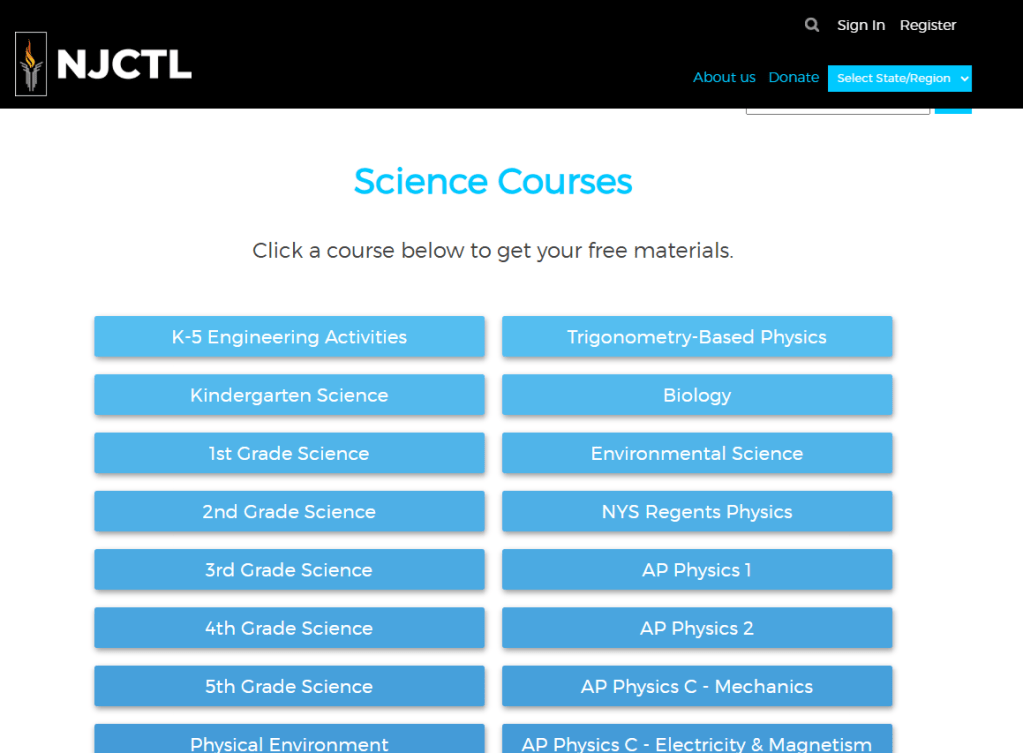
An excellent source of SLOP work is the New Jersey Center for Teaching and Learning – free resources to download.
References:
- Kirschner, P. A., Sweller, J., & Clark, R. E. (2006). Why minimal guidance during instruction does not work: An analysis of the failure of constructivist, discovery, problem-based, experiential, and inquiry-based teaching. Educational Psychologist, 41(2), 75-86. https://doi.org/10.1207/s15326985ep4102_1
- Roediger, H. L., & Karpicke, J. D. (2006). Test-enhanced learning: Taking memory tests improves long-term retention. Psychological Science, 17(3), 249-255. https://doi.org/10.1111/j.1467-9280.2006.01693.x
- Gill, A. S. (Ed.). (2022). Dunlosky’s strengthening the student toolbox in action. John Catt Educational.
- Brown, P. C., Roediger III, H. L., & McDaniel, M. A. (2014). Make it stick: The science of successful learning. The Belknap Press of Harvard University Press.
- Agarwal, P. K., & Bain, P. M. (2019). Powerful teaching: Unleash the science of learning. John Wiley & Sons.

