

… in a system where you HAVE TO give them a grade.
This article refers to High Schools in the US.
- If you teach in the US you can skip to Making the grade about learning
- If you teach in the UK you’ll need the brief overview of Grading in the US for context.
Grading in the US (vs. the UK)
I arrived in the US in 2016 after teaching in the UK for 25 years. In the UK there’s no PowerSchool, Schoology or similar system. Students don’t ‘have a grade in a subject’ until they’ve done an external examination, set by an exam board (not the teacher) usually after 2 years of study. These exams happen at ages 16 and 18.
From the outset I was confused. I started my teaching career the year that Dylan Wiliam and Paul Black published ‘Inside the Black Box’1, so I’ve been wary about grading from the beginning. The idea that a student ‘had a grade’ in every subject at any time was, to me, bizarre. It actually took a while to realize that:
- having a GPA (Grade Point Average) meant averaging lots of grades
- grades are generated by teachers, who have a great deal of autonomy as to what the grade means
- teachers put grades into a ‘student information system’ that calculates a grade for the subject
- average all of those and you have a GPA.
Here’s a sample from a teacher’s gradebook.
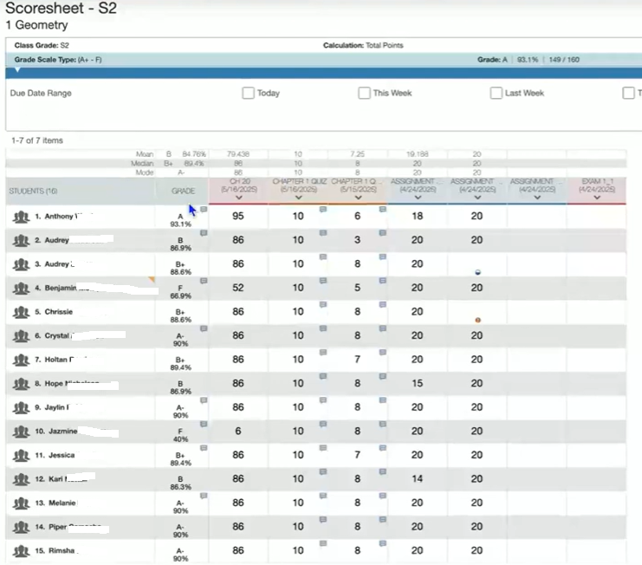
Students and parents can access the grades at any time. Here’s what that looks like:

Grade boundaries are A = 90% , B = 80%, C = 70%, D = 60 %, F < 60%. (Subdivided into B+/- etc. and there is no E). In many student minds, a B is a pass (like a C in the UK).
The system is significantly more likely to produce students who care more about the grade than the learning. You might want to hypothesize some of the consequences for students, teachers AND parents of having such a system. Think about:
- the effect of giving a ‘zero’ for an assignment, or the way a teacher could use ‘giving a zero’
- different teachers having different types of assignments, and weighting them differently
- different teachers having policies about resubmitting that vary from ‘none’ (when the grade is in the system, that’s it) to ‘you can redo it/resubmit’ for partial credit… etc.
Making the grade about learning
From the outset I was keen to find a way to circumvent this system so that if I had to give a grade then the process would incentivize learning in some way. Given that I was teaching students who had been marinading in this system for many years (as had their parents) the major obstacles were:
- if there’s no grade attached to it, they don’t care/try/put in effort
- if there was no chance to change the grade then it effectively became a weekly summative assessment, like having a ‘final’ every week
- they can decide where it will pay off to spend more or less time (gaming the system)
I experimented with various methods and came up with the following principles.
- All work is correctable for 100% credit (except the fall and summer finals)
- Any late work cannot be corrected (the students actually came up with this because they said it wasn’t fair if they worked hard to meet the deadline, but others didn’t).
You’d think that would mean everyone got an A. They didn’t. In fact, when it came to the end of the semester their performance in the final pretty much matched their cumulative grade with corrections. It was useful to keep track of initial scores and corrected scores… I could then have detailed conversations with students/parents/advisors about what was not happening in terms of learning.
Did that mean I was swamped with grading corrections? No… if you check out the How to do Retrieval Practice, you’ll see that RP corrections can be done quickly. For a lot of the homework, most of which is another form of practice, I gave them numerical answers, and they had to show their working out.
Does doing corrections equate to learning? Hopefully, but not always. But what is certainly true is that you learn nothing if you do not interact with what you got wrong and know how to do better next time. So, in addition to this grading system I show them the How Do We Learn material, explain why all the finals are cumulative, and why the retrieval practice includes spacing… because it is the learning that matters in the end, and that means having a long-term strategy to get it into their long-term memory, because the more you know the easier it is to learn.
Unexpected positive consequences
- Physics can be scary, and many students arrive with little confidence that they can succeed. When you can always do better, always improve your grade that fear subsides considerably.
- Parent-teacher conferences were a breeze… once the parents realized that their child had the opportunity to improve then issues about their grade disappeared.
- The numbers choosing physics (it’s an elective in the US) increased significantly.
References
- Black, P., & Wiliam, D. (1998). Inside the black box: Raising standards through classroom assessment. Granada Learning.

