

SPOILER: It’s NOT just puberty.
… And why DO they chat to their friends so much during the lab/practical work? Why is it ALWAYS more exciting to work outside? And why do they remember the explosion SO much better than the science behind it?
It’s puberty, right?
Well, sort of… but that’s only a part of the picture. Broadly speaking the ‘puberty’ part is about the maturation of reproductive organs, and usually happens between 12 and 18 years of age
Adolescence, however, is the period between childhood and adulthood and has been thought of as a social construct relating to both physical and emotional development. It lasts longer than the teenage years extending to the mid- to late- 20s. While the term ‘adolescence’ has been around for centuries it has only been in common use since the early part of the 20th century.
While all this is useful it is only part of the picture; what is fascinating is what is happening in adolescent brains. The information about changes to those brains is all relatively recent because until recently there weren’t tools to investigate brains. The first MRI image of a human wasn’t produced until 1980, and fMRI was developed in the 1990s. Also, research into dopamine (a neurotransmitter in the brain) only produced a Nobel Prize in 2000.
In this blog I’ll bring together some of the information I’ve learned about brains, and how I’ve used it in my teaching, specifically as a lens through which to view the adolescents in my classroom. It’s given me an entirely new way of thinking of the answers to those questions I asked at the start.
Key to this lens is the distinction between biologically primary and biologically secondary learning, and for that reason I’m starting with the infant brain, neurons, neurotransmitters, maturation, myelination, and pruning.
If you’re familiar with those ideas feel free to skip to ‘What’s different about the adolescent brain?’.
The baby’s brain
Once upon a time people thought that a baby’s brain was a ‘tabula rasa’, or blank slate. Everything that the baby would need in order to become a successful adult would have to be ‘written’ onto that blank slate. We now know (from MRI imaging and research) that that is not the case. As Stanislav Dehaene describes in his excellent book ‘How We Learn’1 (summary here),
“The fact that newborn babies immediately exhibit sophisticated knowledge of objects, numbers, people and languages refutes the (tabula rasa) hypothesis… virtually all the circuits of the adult brain are already present in that brain of a newborn baby. “
This means that the baby’s brain is ‘pre-programmed’ to do many things: recognize faces, learn (oral) language, count, have a notion of probability. Why? Being able to do those things immediately confers an evolutionary advantage; the baby recognizes the person taking care of them, can learn to make demands using language, and make predictions about the physical world that are useful.
This is all ‘biologically primary’. You don’t need to teach a baby to recognize faces, it will do that automatically. Similarly, a baby won’t need lessons in the language they will use to communicate with the people around them. ‘How to learn oral language’ is pre-programmed. The baby learns what it needs to learn as it interacts with the environment and these interactions produce changes to its brain.
Brain circuits change when neurons ‘fire’, so here’s a reminder about neurons. The diagram2 shows the basic structure of a neuron.
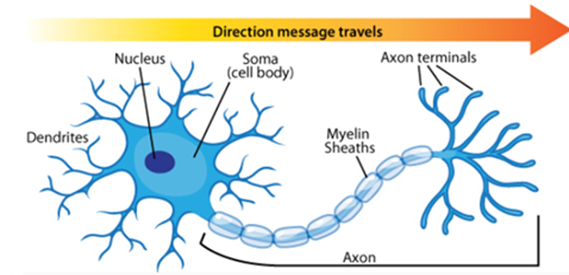
The ‘message’ resulting from a neuron firing is basically an electrical signal that moves through the neuron. Signals can be transferred from neuron to neuron directly by an electrical signal.
Scientists first thought all messages were transferred this way, and then they discovered neurotransmitters.
A signal can also be transferred when chemical neurotransmitters released by one neuron are taken up by another across a synapse or synaptic cleft (basically a gap), as shown in the diagram3.
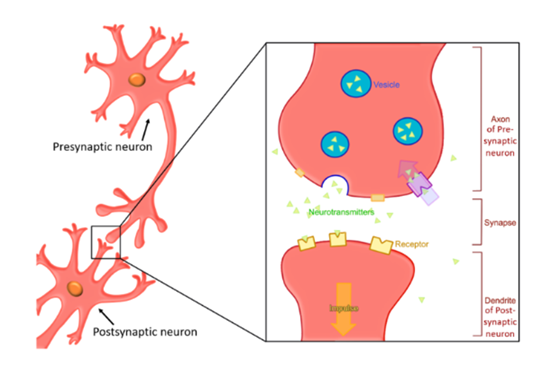
The first chemical to be discovered that acts as a neurotransmitter was acetylcholine in 1926. We now know it plays a role in memory, learning, attention, arousal and involuntary muscle movement. Serotonin and dopamine were found in the brain in the 1950s, oxytocin in the 1970s. (These substances were known earlier; these dates reflect the timeline for understanding their role as neurotransmitters.)
Maturation of the brain
The number of synapses in the baby’s brain increases from birth to the first or second year of life. After that they are selectively ‘pruned’. The process reaches the front and top of the prefrontal cortex (PFC), shown in the diagram4, in late adolescence.
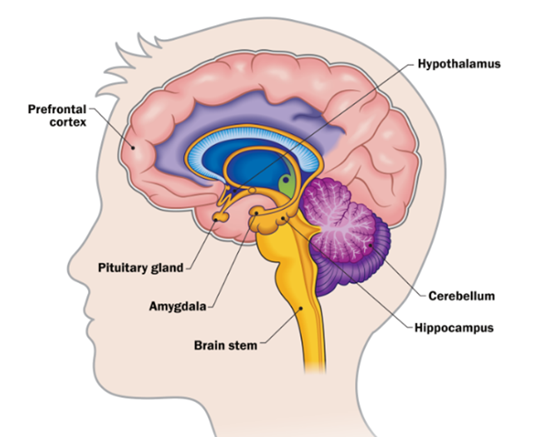
The pruning process works on a ‘use it or lose it’ basis, or as Donald Hebb5 said ‘neurons that fire together wire together’. The synapses that are used more often strengthen and are retained, those not used so often weaken and are eliminated. In this way the brain becomes ‘fit’ for the environment in which the baby/child/adolescent finds itself. This makes perfect sense; the brain is shaped to those caregivers, to that environment.
The ‘strengthening’ of a connection is a result of changes both to the synapse, and to the neurons. There is a thickening of the myelin (insulation) around the axon of the nerve, known as myelination. I say to my students that:
‘Practice makes myelin, and myelin makes perfect’.
There’s an additional benefit to pruning. Connections are energetically costly, so pruning lead to a more efficient brain.
There is also the matter of timing. Regions in the brain mature in order of need: the visual cortex matures first to enable recognition of faces and objects, the pre-frontal cortex associated with regulating behaviour/executive function matures last (for possible reasons I’ll discuss later). The regions of the brain associated with different functions are shown in the diagram6.
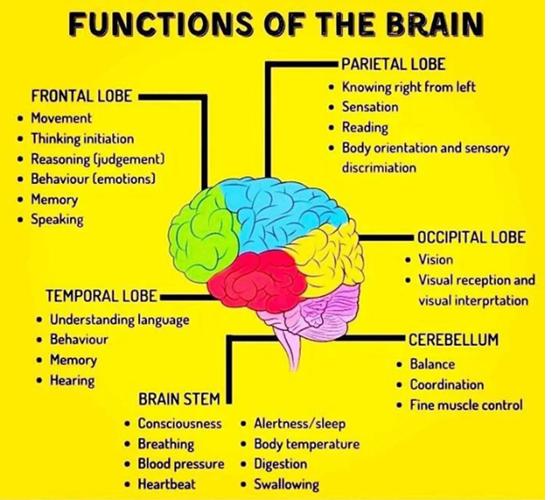
So, different regions are ‘sensitive’ to being changed at different times, and after that there aren’t many changes to those regions.
That’s useful because the brain changes at the times that will confer an advantage to the human who possesses it. It doesn’t mean that no changes happen later but, because of the sensitivity window, you might find it harder to learn language as an adult than as a 3-year-old. (NB: There is always neuroplasticity, a feature of the brain that became apparent between 1960s – 1990s; prior to that there was a strong belief that the brain was a fixed entity.)
So, a child gradually (and automatically) learns what it needs to learn to survive and thrive: how to get food/accept shelter/care from someone else/use language/walk etc.
In education we put children from age 5 – 7 onwards in school and start teaching them things. Their brains change because of what we teach them, but all those things (reading, writing, math(s), science, history…) are biologically secondary. The brain is NOT pre-programmed for that type of learning. Evolution doesn’t work that fast. Knowing how to read books confers no evolutionary advantage (at the moment at least!), but knowing how to locate objects, or ask for or find food, does. We need to teach those things that are not pre-programmed (for reasons I’ll discuss later).
What is different about adolescence?
Adolescence is now thought to happen over a far longer period than was previously thought. It extends beyond the teenage years. Changes to body and brain occur between ages 12 and 24, sometimes longer. Initially, puberty happens and hormones produce the biological changes with which we are all familiar. What I did not appreciate is that there are also significant changes happening within the adolescent brain. Learning about these changes appealed to me because I like mechanisms. I’d like to say that I like mechanisms because I’m a physicist, but it is equally likely that I’m a physicist because I like mechanisms. That is the thing with anything brain related; it’s hard to know which way round things go.
So, why did I include a discussion about synapses and neurotransmitters? It’s because there are two significant changes in the adolescent brain that do not happen to a child’s (or an adult’s) brain. Firstly, there is a steep drop in the number of synapses due to pruning. Secondly, the role of dopamine (a neurotransmitter) in the brain becomes more significant.
The brain of a vulnerable baby is sensitive to inputs that produce changes that help the baby survive and thrive. So, what is the purpose of the changes to the adolescent brain, and what insight does that give us about the students in our classrooms?
For the longest time I associated adolescence with the stereotypes of moodiness, impulsivity, risk-taking, self-centeredness. I thought the mechanism was ‘raging hormones’ resulting in an uncomfortable and challenging period that must be ‘got through’ or ‘tolerated’.
However, while hormones are involved, adolescence also involves the final part of the maturing process in the brain. The PFC matures through the period of adolescence and because of this maturation there is a steady increase in working memory and executive function. It is the last to mature; the brain finally becomes more ‘adult-like’.
Having looked at pruning let’s also look at dopamine.
Dopamine
In addition to pruning, there are significant changes to the dopamine levels and receptors in the brain during adolescence. Dopamine is a neurotransmitter central to our craving for reward, and, crucially for adolescents, in anticipation of the reward. It’s that anticipation that can be a huge driver in behavior. In adolescence (compared to children and adults):
- there is an increase in the neural circuits utilizing dopamine
- their baseline level of dopamine is lower than adults
- the response to dopamine with some experiences (notably risk taking
- social connections with peers, novelty) is enhanced.
Those changes in levels (on a relative scale) are shown below7.
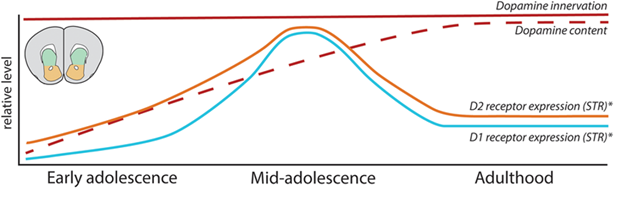
These brain changes can lead to a greater probability of impulsivity, addiction, and hyperrationality (weighing pros much higher than cons). The immaturity of the PFC doesn’t mean there is no reasoning. It’s that in some situations, notably those involving peers, logic and reason are jettisoned. Risk is not evaluated in the same way; the reward is perceived to be much bigger, and the risk perceived to be much smaller than it would be by adults.
How is it useful to think about these changes?
To make sense of this information I found it useful to think about buckets. The buckets are like dopamine receptors. The bell is like the reward that registers when you get enough dopamine.
Here’s the adult brain.
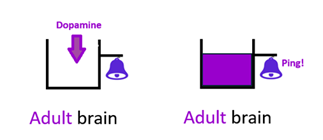
You don’t need to add much dopamine to the adult bucket to ping the bell. A good cup of coffee. Spotting a yellow breasted reed warbler at the birdfeeder. A cat doing that kneading thing on your lap. Ping!
Here’s the adolescent brain.
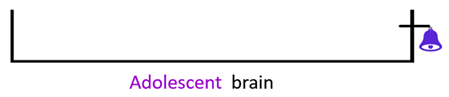
You might have spotted the problem. The bell is at the same level… but…
Yes, indeed. That’s a WHOLE LOT MORE dopamine to get that ping. Where does all that dopamine come from? You’ll know this already:
- Social connections
- Novelty
- Intense experiences or, crucially, the anticipation of those experiences
- Risk taking.
So, yes. They may not respond to the yellow breasted reed warbler in the same way as your adult friend might.
But why is the adolescent brain like this?
Some theories say that these behaviors are mechanisms that result in adolescents becoming better prepared for adulthood in particular ways, for example:
- Evolutionarily, adults were going to need to navigate a social existence, so a long period of sociality and pruning ensures the brain ‘gets it right’ in terms of social memory, emotional perspective taking, impulse control, empathy, ability to work with others, and self-regulation. The maturation process happens significantly later than other processes and so has a significant dependence on the environment. This makes sense because it is that environment these young adults will inhabit.
- And/or evolutionarily, some way was needed to get the adolescents away from the adults. Basically, there must be some mechanism to get them out of your house. Otherwise, why would they ever leave? Food, clothes, laundry, devices, and a lovely warm bed. They’d stay forever.
- And/or the link between dopamine and social connection also ensures that they transfer their attachments to a group to whom they are not biologically related. That means their friends start to matter to them a great deal because evolutionarily they could have depended on this group for survival.
- And/or, for the human race as a whole, we need people who will explore new avenues, push boundaries; to not have done so could have resulted in stagnation.
In all these senses these mechanisms are biologically primary. We don’t need to teach adolescents to care what their peers think or the importance of taking risks. Their brains reward the behavior that gives them the social skills they are going to need for the future.
(NB: This is a complex area… I am simplifying and pulling out some ‘useful ways of thinking about the adolescent brain’.)
Using the bucket lens
Using ideas about the adolescent brain as an additional lens through which to view what’s going on in the learning environment/my classroom has been immensely helpful to me. Here are some ‘bucket’ examples, and I imagine you can think of more:
- When they say ‘it’s boring’ I think about their bucket. I can’t tell you how much this has helped me to reframe many things students have said. Also, if you teach the students about the bucket, it’s really empowering for them; a different piece to ‘metacognition’.
- All those times when they said, ‘can we work outside/can we play a game’… that was because novelty is a big ‘hit’. And all that stuff when they try to get you off track, talk about what you did at the weekend. The bucket is calling.
- Those exciting demonstrations (elephant’s toothpaste, whoosh bottle – you can Google them) resulted in them remembering the demonstration but not having any idea what the science was because they’d filled the bucket and didn’t feel the need to exert any cognitive effort to understand the science.
- All the activities involving working with a group of friends, and those conversations quickly moving to exciting things that happened at the weekend, or exciting things that are going to happen at the weekend… it’s not that they’re ‘misbehaving’. It’s an opportunity to do what they need to do, just like learning to recognize the faces of their family as an infant. Also, they don’t have the ‘over-ride’ button from the fully mature PFC that we have when we refrain from similar conversations during teacher (C)PD. That ‘over-ride’ is that last thing to get sorted out in the maturing process. Why? If it happened earlier, it would get in the way.
In the classroom I’m very aware of the allure of the bucket for an ‘easy win’ (games, competition with peers – see my piece on tech here). I’m also aware that these short cuts won’t result in the learning that I want for my students.
There is a lot more to brain chemistry and brain development that results in learning, but there is a lot of evidence that learning requires cognitive effort (Bjork, 1994). The learning I want for my students will be the result of the cognitive effort they apply; that effort does result in a reward, but it just takes longer and is not immediate.
Cognitive effort links back to efficiency; there’s still a biologically primary drive to conserve energy even in adolescence, and perhaps even more so. (There are also changes to sleep patterns in adolescents that play a role, but I won’t discuss in detail here). Evolutionarily, energy may have been a very precious resource, so having a driver to exert as little cognitive effort as possible is understandable. (NB: The brain uses around 25% of the calories you consume.)
The pruning lens and learning
As I have discussed here, I’m a big fan of explaining the learning process to students. The idea that ‘neurons that fire together wire together’ provides a mechanism for explaining why a lot of the strategies I use with them work. For example (but not exclusively):
- retrieval practice
- spaced practice
- interleaving
- forgetting (well, trying to remember as you are on the point of forgetting).
Clearly, the importance of attention becomes obvious. Nothing’s going to fire if you’re not looking at the right thing, and this means that any practice needs to be deliberate.
There is also the idea that ‘the more you know the easier it is to learn’. Building connections that are strong gives newer connections places to connect to!
The brain and learning process are, obviously, more complex than I have presented here. A comprehensive review was not my aim. There are a lot of questions to ask about how our teaching can accommodate these changes to the adolescent brain. The delicate balance of using novelty to secure attention so as to promote cognitive effort without simply filling the dopamine bucket in ways unrelated to learning is one obvious concern.
The pruning lens and schools
It is during adolescence that the largest number of connections are pruned. Adolescents are homing in on what’s important to them as individuals and are finding their passions. Evolutionarily there were not that many options in that particular arena, but now they have the whole of human history to choose from… which brings me to schools and what schools are for.
To me the purpose of education has always been to expand horizons beyond the immediate environment into areas that they would never otherwise think to explore. It’s awe and wonder. It’s agency. It’s appreciation, and this is what schools are for (see my blog here). Significantly, acquiring that knowledge needs instruction because it is biologically secondary.
This drastic pruning is as it should be. They are making their brains ‘fit for purpose’ in many ways, and knowing the things that they’d like to explore more deeply in their lives is useful; they can’t do everything. But what can or should be the things from which they choose? This is the time when the environment plays a huge role. This is an opportunity for them to be exposed to things to which they would not ordinarily gravitate, to be shown a world (of science, literature, history… and more) beyond that which they would normally experience. Expanding horizons. Sowing seeds of interest that can blossom later. That means a knowledge-rich curriculum encompassing a wide range of subjects is essential to any school. It’s my role to show them the world of physics not for the purpose of utility, but to give them that option. To not do so would be negligent… the same applies to all the other subjects that make up a broad and balanced school curriculum.
As you’ve possibly begun to appreciate, viewing what happens in schools through this particular lens makes some conclusions inevitable (for me):
- allowing adolescents to choose what to study in school is extremely limiting and to be avoided
- it is the responsibility of schools/districts/states/government to provide adolescents with a rich experience of a wide range of different aspects of human culture: history, science, languages, arts, sports in addition to math(s), reading, writing
- every expert teacher visibly demonstrating the passion they have for their subject is extremely important because it opens the eyes of students to a world they wouldn’t otherwise know.
For those of you who follow me on X (@helenrey) you may be thinking that my position on certain issues now makes a lot more sense. I hope so. It’s been a revelation to me over the last 25 years and I sincerely believe in the power of the school curriculum to expand horizons, increase options, and enrich the lives of the adolescents we teach.
Caveats:
This is a far more complex topic than I can hope to cover in a blog post (that is already very long). Let me point out some obvious caveats.
- The brain is complex. I’m using the significant changes in terms of dopamine and pruning as one might talk about the amygdala and the fight/fight/freeze/faun mechanism. (That will be another blog; what about that in the classroom?)
- There are individual differences that I did not explore.
- There is neurodiversity and how that impacts individuals, again a very important topic for which there is no space here.
- As Dylan Wiliam pointed out on X, there are other biologically primary ‘skills’: generalization, transfer, general problem solving. No room here, but one of many ‘follow-up’ blogs to come.
References:
1. Dehaene, S. (2021). How we learn: Why brains learn better than any machine… for now. Penguin, pages 69/70.
2. Dr. Biology. (Tue, 05/03/2011 – 16:43). Neuron Anatomy. ASU – Ask A Biologist. Retrieved from https://askabiologist.asu.edu/neuron-anatomy, accessed 14 July 2026.
3. Communication Between Neurons, Anatomy & Physiology. Authored by: OpenStax College. Retrieved from https://courses.lumenlearning.com/suny-dutchess-anatomy-physiology/chapter/communication-between-neurons/, accessed 14 July 2026.
4. Brain Anatomy and How the Brain Works, Johns Hopkins Medicine.https://www.hopkinsmedicine.org/health/conditions-and-diseases/anatomy-of-the-brain accessed 14 July 2026.
5. Hebb, D. O. (1949). The Organization of Behavior: A Neuropsychological Theory. New York: Wiley and Sons.
6. CAHMS Professionals, https://camhsprofessionals.co.uk/functions-of-the-brain-%F0%9F%8C%8D/ accessed 14 July 2026.
7. Reynolds, L. M., & Flores, C. (2021). Mesocorticolimbic dopamine pathways across adolescence: diversity in development. Frontiers in Neural Circuits, 15, 735625. https://www.researchgate.net/publication/354443951_Mesocorticolimbic_Dopamine_Pathways_Across_Adolescence_Diversity_in_Development
General references. I can’t reference everything I’ve read, but here are some examples:
- Sapolsky, R. M. (2017). Behave: The biology of humans at our best and worst. Penguin. Chapter 6: Adolescence; or, Dude, Where’s My Frontal Cortex?
- Steinberg, L. (2020). Adolescence. McGraw Hill. https://www.mheducation.com/unitas/highered/sample-chapters/9781260058895.pdf
- Spear, L. P. (2013). Adolescent neurodevelopment. Journal of adolescent health, 52(2), S7-S13. https://pmc.ncbi.nlm.nih.gov/articles/PMC3982854/
- Siegel, D. J. (2015). Brainstorm: The power and purpose of the teenage brain. Penguin. Part I: The Essence of Adolescence, Part II: Your Brain.
- Synaptic pruning, Cleveland Clinic, https://my.clevelandclinic.org/health/articles/synaptic-pruning, accessed 17 July 2026.
- Geary D. C. (1995). Reflections of evolution and culture in children’s cognition. Implications for mathematical development and instruction. The American psychologist, 50(1), 24–37. https://doi.org/10.1037//0003-066x.50.1.24

