
What are you doing? Let’s step back a moment.
What’s the point?
What are you trying to do?
What is the goal that you want for your students?
My goal is that the students ‘see it like I see it‘.
Why? Physics is an amazing lens through which to view the world which inspires awe and wonder and, given its contribution to the world, is a cultural entitlement of every student in school.
(Replace ‘physics’ with your subject… I bet it still fits.)
How? To ‘see it like I see it’ students will have to know a lot of what I know.
It has taken me a long time to realise this. I spent many years thinking there was a thing called ‘thinking like a physicist’ which I was trying to impart to them. I realise now this is meaningless. Without a lot of physics knowledge they had no way of thinking in the way physicists do. They had nothing to think with.
To see it like I see it they need to know lots of physics.
This is not regurgitating facts. It’s having sufficient knowledge to make meaningful connections, to make sense of phenomena, to suggest solutions, to ask interesting questions. To wonder why and to have some idea what the answer might be.
What does a cognitive science (cogsci) lens offer?
Cogsci is not a pedagogy, or set of rules. Just like knowing physics gives you a perspective on the world, knowing cogsci gives you a perspective on teaching and learning. I call that a ‘cogsci lens‘.
Using a cogsci lens helps students learn more, and more efficiently.
NB: I haven’t mentioned grades, tests, scores. If I teach them so that they know, understand, and can apply their physics then the grades, tests, scores take care of themselves. They do.
Here are the mini-lenses that make up the cogsci lens through which I now view ALL my planning, teaching, and reflection, together with an example of things I do/think or no longer do/think as a result of knowing cogsci.
My mini-lens
As a result, I now…
Willinghams’s model of memory
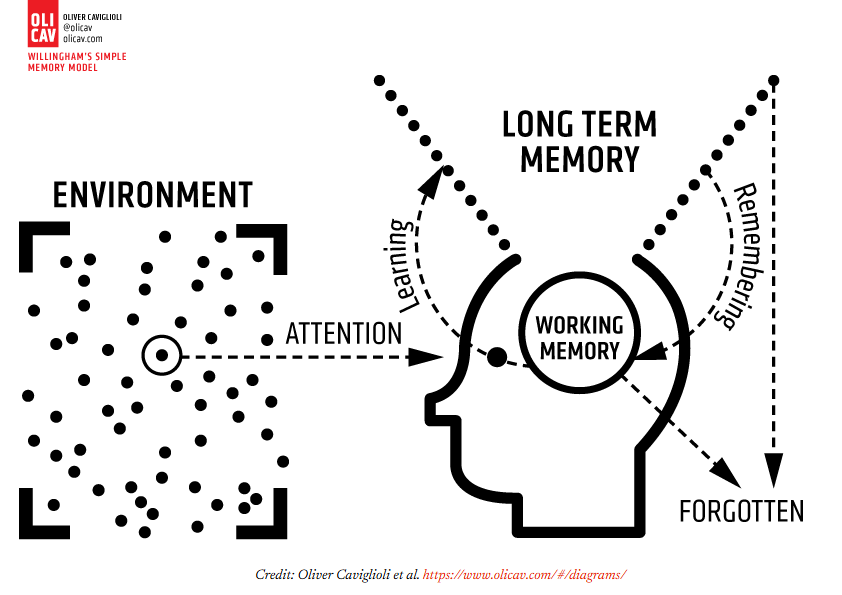
… use direct instruction, check for understanding WAY more often, implement retrieval practice and SLOP**, tell the students about the model.
Novices are NOT little experts.
…plan activities/problems depending on where they are on the novice-expert spectrum
…don’t teach by getting them to attempt real world problems that would challenge experts (it was the end of those projects/jigsaw/web hunts)
Learning* is a change to the long-term memory (LTM)
… don’t judge what they have ‘learned’ by short-term performance (exit tickets/ a test straight after learning something)
The curse of the expert
…remember things that are REALLY OBVIOUS to me are NOT REALLY OBVIOUS to them AT ALL (game changer right there)
Working memory is limited/Cognitive Load Theory
… realise that if they are lost/seem to have switched off it’s almost certainly my fault (hard to swallow, but usually true).
… check to see if I have overloaded their working memory (I usually have)
The testing effect is real/testing IS learning
… use low-stakes retrieval practice often, use mini-whiteboards every lesson with everyone (all ages)
You need lots in your LTM because ‘You CAN’T just Google it‘
… challenge the notion that people have/need to offload their memory to the Internet so students don’t need to use their LTM
… do the assessments I use to judge their progress/ evaluate my lessons with paper and pencils in front of me (because they can Google it).
High stakes testing is not effective
… make all work 100% correctable for 100% credit (except finals in the US)
… reduce number of tests other than finals to zero (again, in the US)
… finals worth 20% of overall grade (in the US)
**SLOP = Shed Loads Of Practice (a term I first heard Ruth Walker use at ResearchED Rugby in 2017)
 It's a Learning Curve