
If you like to watch a video, watch the video.
If you like to read, here’s the same information**:
1. Learning is a change to your long-term memory (LTM)1.
- This is key, and this is how learning works for EVERYONE doing EVERYTHING. Physics, basketball, skydiving, playing lead guitar, gaming… tying your shoelaces. Everything.
- Luckily, your LTM is pretty much infinite2.
2. There is a really useful model of memory3 that is widely used:
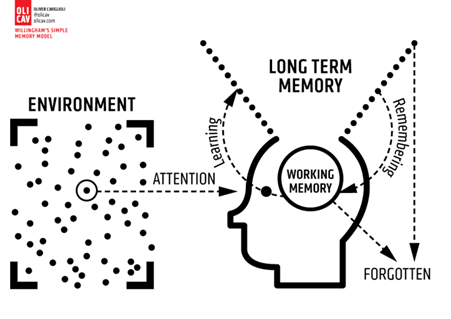
3. You control what you pay attention to in your environment. Yes, you do. Try it.
- Treat your attention like it’s the most precious thing you have, because it is the most precious thing you have. (While we’re on the subject, people make money from YOUR attention. Don’t give it away to them).
- Things you attend to go into your working memory (WM)4. This is NOT infinite. This is very limited. Don’t feel bad – everybody’s is. It’s not just you.
4. Your WM is not just your short-term memory (STM). In your working memory you do two things:
- you hold the information you’ve attended to (this is your STM)
- you do things with it – you process it, or combine it with things you already know, and make meaningful connections, connecting it to the bigger picture.
5. With practice it ends up in your LTM.
- That’s a bit of an understatement. It takes a lot of processing to get things into your LTM.
- Luckily there’s a fair amount of research that shows what does work well, and what doesn’t (and that’s why I’m here).
- You may be used to doing things that don’t work very well (get ready for that – it won’t feel good to find that out, but that’s ok).
6. You forget stuff.5 Everyone does.
- The trick is to try to remember something just as you are about to forget it, or when you think you have.
- Memories are not bits of paper in filing cabinets. The act of remembering ‘generates’ them.6 (This is very cool, though it does mean that eye-witness testimony may not be as reliable as we think).
7. There’s no such thing as ‘smart’. I’m adding this because it’s so very, very unhelpful. Especially for those people in school.
- Learning is ‘effortful‘. You have to pay attention, process things, try to remember things.
- Some people may appear to make connections easily. You might say they ‘get it quickly’. That will be because they have, somehow, got things in their LTM to tack it on to… the biggest correlation here is with people who have read a lot of books. Any books. If you want to make it all very easy then read. A lot. Start today.
- Analysis of people perceived as being a ‘genius’ shows they’ve had a huge input into their LTM at some point. Mozart is a case in point.
Find out about study strategies that work here.
Find out if you’ve been wasting your time here.
* This is a summary designed for those for whom these ideas are very or relatively new. There are very, very many details that I have omitted. In the strategies/resources/booklist sections you’ll find more detail. I will be expanding on a lot of the details in later posts.
** In NO way does this imply there are learning styles. Learning styles are a myth. People, however, do have preferences. NB: if you want to do even better in school (or in general) , ACTIVELY do things that are NOT your preference.
References
1 Kirschner, P. A., Sweller, J., & Clark, R. E. (2006). Why minimal guidance during instruction does not work: An analysis of the failure of constructivist, discovery, problem-based, experiential, and inquiry-based teaching. Educational Psychologist, 41(2), 75–86. https://doi.org/10.1207/s15326985ep4102_1
2 Atkinson, R. C., & Shiffrin, R. M. (1968). Human memory: A proposed system and its control processes. In K. W. Spence & J. T. Spence (Eds.), The psychology of learning and motivation: Advances in research and theory (Vol. 2, pp. 89–195). Academic Press.
3 Willingham, D. T. (2009). Why don’t students like school? A cognitive scientist answers questions about how the mind works and what it means for the classroom. Jossey-Bass. Diagram by Oliver Cavaglioli https://www.olicav.com/#/diagrams/.
4 Miller, G. A., Galanter, E., & Pribram, K. H. (1960). Plans and the structure of behavior. Holt, Rinehart and Winston.
5 Ebbinghaus, H. (1885) Translation (1913). Memory: A contribution to experimental psychology (H. A. Ruger & C. E. Bussenius, Trans.). Teachers College, Columbia University. (Original work published 1885)
6 Bartlett, F. C. (1932). Remembering: A study in experimental and social psychology. Cambridge University Press.
 It's a Learning Curve