
” Ok, fine. But what do you actually DO?”
I get asked this a lot, so this page is for ‘THIS is what I do*’.
I’ll put it in phases, where a ‘phase’ was about a year, with a concrete example where possible. (NB: I was always an extensive user of mini-whiteboards (how to use them coming soon!) – please get a set and use them).
Phase 1 – Introduced retrieval practice
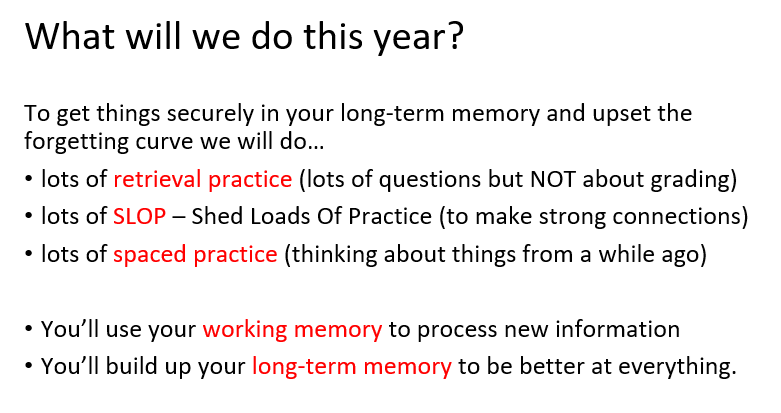
Started weekly retrieval practice with my classes. Low stakes – one question from last lesson, one from last week/month, one from a long time ago. 100% correctable.
I’d done quizzes, but adding in ‘a long time ago’ had a significant positive impact.
Continued use of mini-whiteboards.
Example:
Retrieval Practice – Mon 8th Jan
1. Last lesson:
Explain why a charged balloon picks up a piece of paper.
2. Two weeks ago
Calculate the energy stored in a spring with a spring constant of 50N/m if it is stretched by 2mm.
3. Six weeks
Draw a free body diagram for a ball rolling across the ground after it is no longer in contact with your foot.
Phase 2 – Refined retrieval practice, more explicit instruction, less performance
As above… AND changed the RP questions to get deliberately get more complex/abstract/unfamiliar over time within each topic.
Made 100% of homework 100% correctable for 100% credit (because it’s about the LEARNING NOT THE GRADE).
Realised there was a lot of distraction in the actual teaching part. Used fewer anecdotes/distracting videos.
Example (over time):
Draw a free body diagram for a ball falling (ignoring air resistance). Label the forces.
Draw a free body diagram for a leaf falling from a tree at a constant velocity. Do not ignore air resistance. Label the forces.
Draw a free body diagram for you in a car on a freeway doing a steady 65mph.
Draw a free body diagram for a ball rolling across the ground after it is no longer in contact with your foot.
Phase 3 – Teaching metacognition, spaced homework
As above… AND designed a one lesson introduction to the brain and learning. Did it with all my classes.
(A bit nervous doing it).
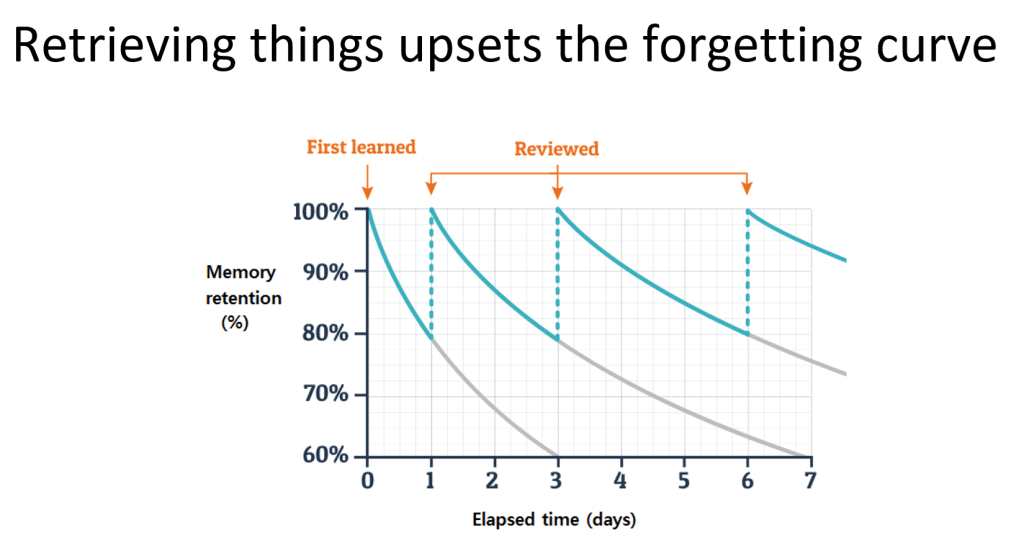
Started spaced practice by deferring homework (SLOP) until 2 weeks after we’d done it in class.
Made most AP (A level) homework is SLOP (Shed Loads Of Practice) with interspersed AP questions.
Phase 4 – More teaching metacognition, talking about research
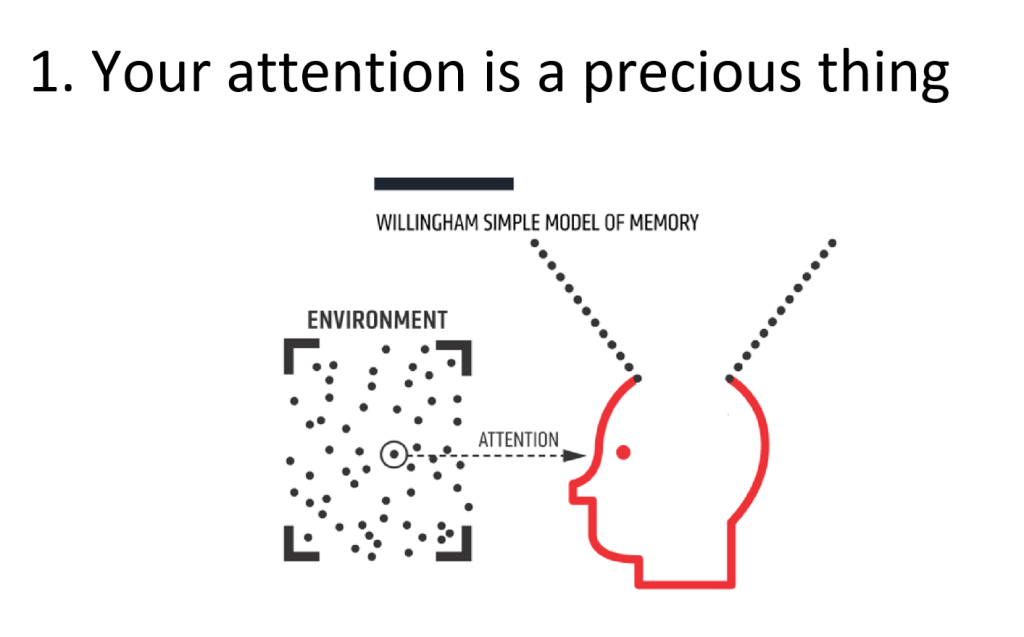
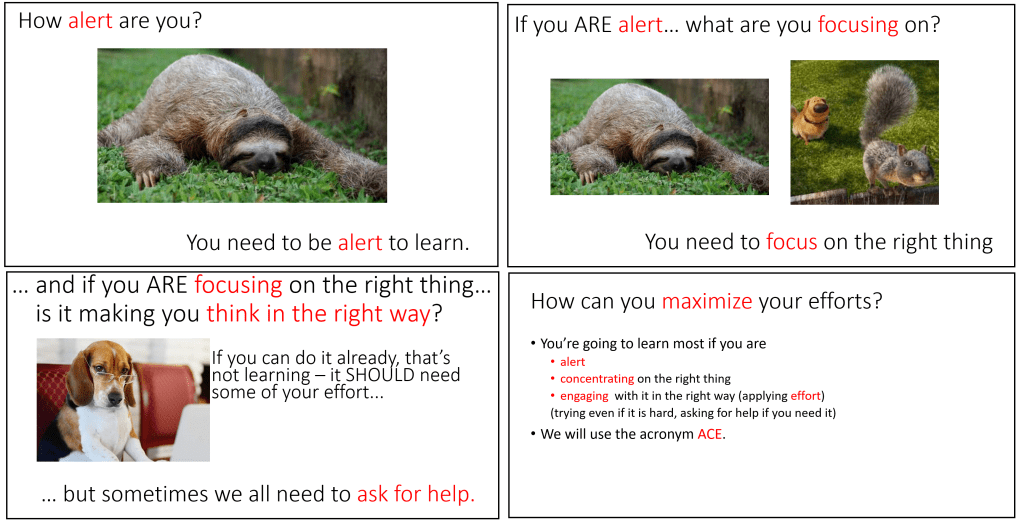
As above… AND refined the one lesson introduction to focus on attention/ distraction. Told students about the research. Graham Nuttall’s 3 things is SUPER sticky**.
(A lot braver doing it).
Continued with AP (A level) homework to SLOP. Planned for better increase in complexity/unfamiliarity of context. Required a reflection paragraph.

Phase 5 – Even more teaching metacognition
As above… AND honed in on attention with the Posner and Rothbart*** model of attention.
(Very bold, cogsci is important, you will learn about it) .
Explicit instruction about study strategies integrated into the curriculum.
With AP (A level) homework required a detailed reflection paragraph (I gave examples).
I also included material about the default mode network to help students understand about why getting a low grade can be so distressing. Find out more here.
*However, I have been doing the ‘cogsci lens’ for about 8 years. I started tentatively and a little nervously (you might be feeling the same way) and over that time I’ve become bolder and more robust.
** Graham Nuttall (2007) observed that students had to interact significantly with the material AT LEAST 3 TIMES before the knew it. It’s the Rule of Three (in my class).
Nuthall, G. (2007). The hidden lives of learners. NZCER Press.
*** Rueda, M. R., Posner, M. I., & Rothbart, M. K. (2005). The Development of Executive Attention: Contributions to the Emergence of Self-Regulation. Developmental Neuropsychology, 28(2), 573–594.
 It's a Learning Curve